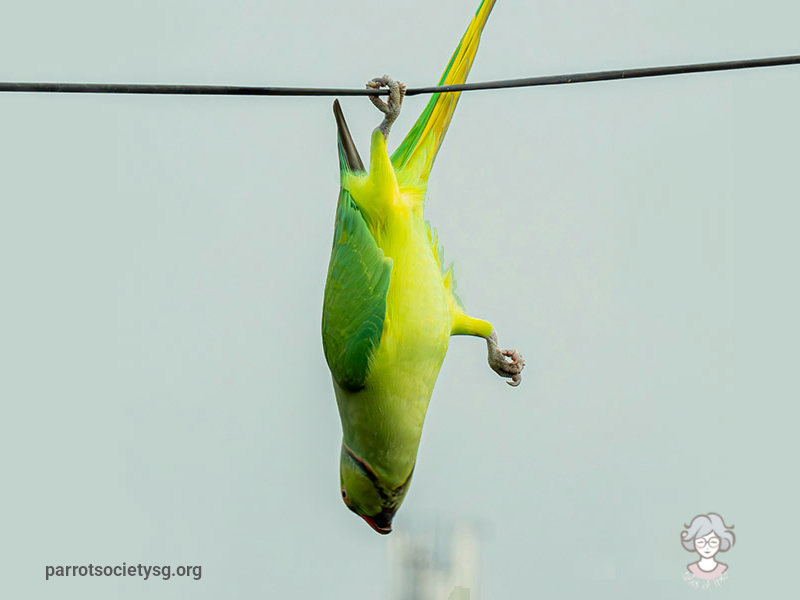
There was once a parakeet who wanted to be a bat. Every morning as I walked past, there it was, hanging on to the overhead wires. While all the other parakeets perched dutifully upright as birds are wont to do, this one hung upside down, tail held up to the sky, squawking defiantly.
Of course, parakeets turn and twist themselves into fantastic positions on slender branches while feeding; but to hang like a trapeze artist while resting? Was it, I wondered, an expression of rebellious adolescent behaviour in the parakeet world? Or was it a fascination with that shadowy creature which flew silently past its nest at dusk? Or was this parakeet in the throes of an identity crisis?
Born to be different
It made me think. What happened to those who were born to be different in the animal world? How far could this parakeet who wanted to be a bat take its urges, besides merely hanging upside down? Its DNA was coded for Class Aves, Order Psittaciformes; not Class Mammalia Order Chiroptera! He could possibly choose to start his day when the others of his kind finished theirs, but his biology would not permit him to navigate the darkness, find his food or avoid predators.
And what would its place in the parakeet society be? Would it be cast out by its ilk for daring to be different, and equally, would it be rejected by the bats for being an outsider? Forever on the fringes of parakeet society, alone, ostracized and misunderstood? Or would its avian family look on indulgently, allowing it to be just a little different, not quite understanding but accepting? As they seemed to be doing right now, ignoring its wilful stance!
The cat with acrophobia
I once spotted a stray cat with acrophobia. Many kittens do hesitate to climb trees or jump off them. I once watched a mother feline patiently wait for her three kittens to follow her up a tree—stopping, looking back encouragingly, even demonstrating the technique more than once. But this was unusual. This was a grown cat. It stood rather gingerly at a bend of the rain tree, barely three feet above the ground, took a faltering step forward, backed off, stood a long while, looking around. For help, perhaps? This was clearly a feline who had no head for heights.
What would its future be? Was it condemned to remain grounded forever? While the cats and dogs who shared the society strolling rights had a tacit truce pact, I doubt it operated beyond the gates. It would be perilous to negotiate the outside world without the agility to jump to safety. So what choice did it have? To lead a solitary life limited by its fears—or to try and overcome them. Daily challenging itself to small feats. Alone. No-one to provide encouragement, no-one to reward the tiny victories. Just the overwhelming need to survive.
The dog with two tails
A few years ago, a little pup walked in through the gates of our colony, wagging its shaggy tail. A non-descriptive tan and white, of unknown pedigree, but with a tail with a difference. A plume of hair from the root branched out in a determinedly different direction. The adults thought he was cute, the children fawned over him. They petted him, fed him little tidbits, and the dog with two tails became the mascot of the society.
Yes, it was possible to be different and be accepted. And loved.