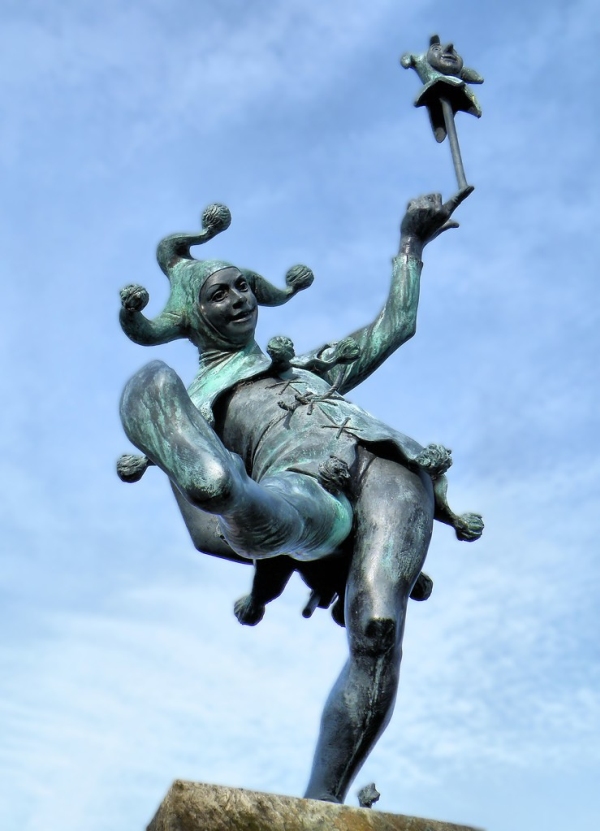
April Fool’s day is just past. A good time for celebrating the fool. I know my choice of muses is rather foolish, but I find no shame in it. For the fool is not just a ridiculous figure, a simpleton, an object of mockery. He is a man of many parts. The poet Kalidas knew his worth, Shakespeare made him famous, operas made room for him, and movies were incomplete without his presence! As for the audience, they’ve always loved him.
But who was he in real life?
Though the fool (or jester) became a well-known persona only in medieval times, he has entertained royal courts and households since time immemorial. While no historian has given him serious thought, the jester has played the fool all the way from China through ancient Persia and Rome to the Aztec court. For humankind lives not by bread alone, but by moments of shared fun and laughter. This was the fool’s life and his livelihood. His skills were manifold—acrobatic, juggling, wordplay, mimicry, magic, music and dance—he was the Jack-of-all-comical-trades!
The Bard and the Fool
It was Shakespeare who immortalised the fool. He created Puck and Nick Bottom, Falstaff and Feste, Speed or often simply, The Fool. He elevated the fool’s stature beyond a mere source of comic relief to a multifaceted figure. In his hand, the fool became a wordsmith par excellence, a master of wit, innuendo, double entendre and repartee. He was a raconteur, a messenger, a go-between, a loyal comrade or aide to the main character(s). Even more importantly, he was the mirror in which the hero, the villain, or society with all their weaknesses and idiosyncrasies was reflected. As a ‘licensed’ fool, he was allowed to speak his mind and utter words of wisdom and truth with the simplicity that he personified. Much like the child in ‘The Emperor’s New Clothes.’
Kalidas and the Vidushaka
Familiar though I was with the Shakespearean fool since my schooldays, I was pleasantly surprised to find him in the plays of Kalidasa. There he was, in the role of the Vidushaka, in Abhijnanashakuntalam, and the lesser-known Malavikagnimitram and Vikramorvasiyam. He was there too in Shudraka’s Mricchakatika, his role spanning the entire length of that timeless play!
Loyal friend and confidante of the hero, he is the voice of reason and the often (unwilling) co-conspirator in his amorous adventures. He too is a man of many parts—a wit, an aesthete, but also a simpleton who loves his creature comforts. Sanskrit drama was celebrating the fool many centuries before the Bard reinvented him!
The lost fool
Much like the stage from which it evolved, both Indian and world cinema celebrated the fool. The hero’s sidekick, the butt of many jokes, but always with a heart of gold. And who can forget The Tramp—Charlie Chaplin bringing the unsophisticated, bumbling, childlike fool centerstage!
Sadly, as time went by, the role of the fool diminished. He was reduced to a unidimensional bumbling alcoholic, his antics and jokes degenerating into crassness. But perhaps this too was a reflection of society. In both reel and in real life, we have dispensed with the all-seeing fool who could criticise without offending, making us smile at our own foibles. Their role has been usurped by those who in their clowning bring out the worst of the fool. His verbosity without wit; his brashness without insight and without his self-deprecating humour.
The real-life fool
So I was delighted when on April Fool’s Day I was forwarded some clips of those they call stand-up comedians. They poked fun at our penchant for superfoods, our petty neighbourhood squabbles, the corporate culture. They gently mocked our superstitious fears, our obsession with fair skin, gender disparities. The fool was alive, if not quite well.
Let’s bring him back. And celebrate the fool, who like Feste in Twelfth Night is ‘wise enough to play the fool’.
2 responses to “Celebrating the Fool”
Very well researched article with lot of insight.
Thank you, glad you liked it.